
Services


Why DeltaXignia
Why DeltaXignia

Why DeltaXignia
By Business Case

Version Control & Collaboration

Data Consistency & Management

AI & Automation
By Industry

Aviation

Manufacturing

Legal

Financial Services

Life Sciences
Why DeltaXignia
Why DeltaXignia
By Business Case
Version Control & Collaboration
Data Consistency & Management
AI & Automation
By Industry
Aviation
Manufacturing
Legal
Financial Services
Life Sciences

Last updated: 10 February 2026
Legal teams aren’t short on expertise; they’re short on scalable content change management solutions.
Every regulatory update, law revision, or policy amendment sets off a complex chain of document updates, reviews, and approvals, yet many legal workflows rely on manual reviews and outdated technology, simply not fit to handle continuous change across the mix of unstructured formats like DOCX and PDF and structured formats such as XML. Research shows that legal teams spend as much as 11.2 hours per week dealing with document creation and management challenges, with about 6 hours a week wasted on documentation issues, a hidden cost that compounds when legal teams are navigating multiple document versions, formats, and systems. The result is growing operational risk, inconsistencies, and governance models under pressure.
For legal operations and technology leaders, evolving legal workflows is essential to maintaining control, confidence, and compliance.
Unmanaged content change is one of the most common, and least visible, sources of risk in legal environments. Many legal teams still depend on manual revisions and a patchwork of legacy tools: word processors, spreadsheets, email chains, and static document repositories. While familiar, these tools were never designed for continuous, large-scale content change management. In fact, 90% of “proofread” legal documents still contain errors, emphasizing how traditional content change management practices break down at scale.
When updates are tracked inconsistently and reviewed using legacy tools, organisations expose themselves to errors that can cascade across multiple documents, systems, and teams. Industry analysis of law firm workflows suggests document management challenges cost firms approximately 9.8% of their total productivity, translating into less time spent on billable work and more time on administrative overhead. This underscores a critical reality: accuracy at scale cannot rely solely on human effort. As content volumes increase, manual quality control becomes both unsustainable and unreliable.
What’s needed is a structured, scalable approach, one that treats content change management as a defined lifecycle rather than an afterthought. That shift starts by rethinking how change is detected, processed, and understood across legal documentation at scale.
To manage legal documentation effectively at scale, you need to first rethink content and data change management as a structured lifecycle rather than a series of ad hoc tasks. Whether teams are working in highly complex enterprise environments or more autonomous, self-managed SME organisations, effective content change governance follows the same core lifecycle, which can be applied through the Find-Decide-Trace Framework.
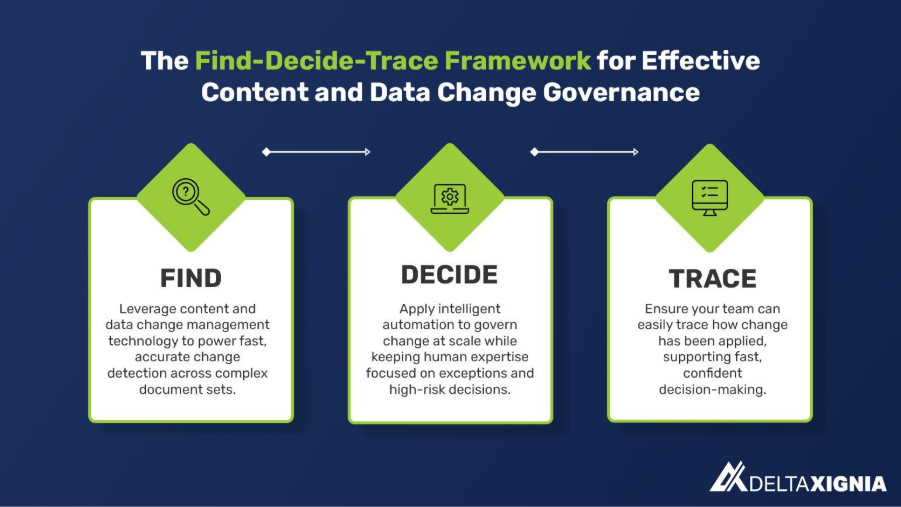
The first challenge is knowing what has changed from one version to another. A regulatory update or court decision can impact hundreds, sometimes thousands of templates, precedents, guidance notes, and client-specific variants stored across different systems. For legal teams who need to manually review these large document sets, the whole process is tedious and increases the risk of human error.
This is where a scalable, high-accuracy content and data change management solution is critical, allowing legal teams to find change across large document sets at speed while maintaining confidence that all relevant differences have been identified.
Once change is detected, legal teams must decide how each change should be handled. At scale, making these decisions manually across hundreds of documents becomes slow and inconsistent. Using the right content change management technology allows legal teams to process change intelligently, supporting rule-based automation while keeping human judgment in the loop for exceptions and high-risk decisions.
After decisions are made, it is essential to trace how change has been applied. Legal teams need clear, human-readable view into what changed, where it changed, and how it was handled. Manually going through hundreds of pages just to find which section changed is an unnecessary bottleneck that slows down reviews and diverts expert time away from higher-value work. Effective traceability makes change transparent and auditable, enabling faster review, stronger governance, and greater confidence that updates have been handled correctly.
The value of structured, scalable content change management technology, built around clear principles for finding change, making informed decisions, and maintaining traceability, is already delivering measurable results for legal information providers worldwide. Whether you are managing large volumes of legal documentation internally or migrating vast content libraries from one system to another, robust content change management is critical. Choosing the right technology can drastically accelerate these processes while ensuring the level of precision and reliability that legal environments demand.
For example, Karnov Group, a leading Nordic legal information provider, used DeltaXignia as part of a large-scale content migration project, successfully merging more than 16,000 XML files into a single, unified source of truth through a fully automated pipeline. By leveraging DeltaXignia’s high-precision content change management capabilities, Karnov was able to validate large volumes of content efficiently and establish a reliable foundation for ongoing updates at scale.
Another great example of impact is Richard Boorberg Verlag, a long-established German legal publisher, which uses DeltaXignia to manage highly granular structural changes across its vast range of legal publications. This enables Boorberg to process complex updates more efficiently, reduce manual effort, and maintain strict editorial control and governance across evolving content.
“Quite simply, DeltaXignia Compare saves me time. If you just get a visual result, then you need many, many hours to consume that and understand what’s really going on. With this solution, I can move quickly from detecting issues to deciding how best to resolve them.” - Dr Wolfgang Schindler, Richard Boorberg Verlag
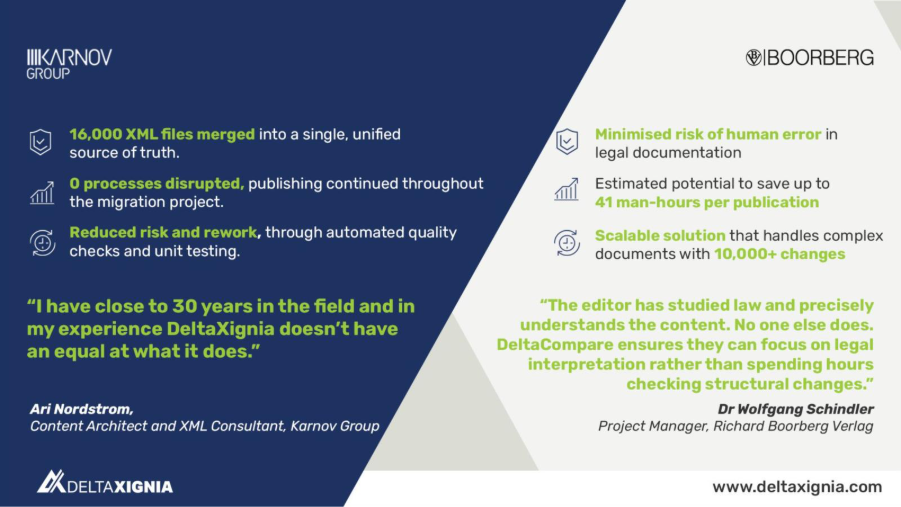
Ultimately, managing legal documentation at scale requires a fundamentally different approach to change, one that is structured, repeatable, and designed for continuous evolution. DeltaXignia’s role in enabling precision updates, large-scale migrations, and continuous governance demonstrates how the right technology can turn change from a source of risk into a managed, reliable process.
Built to operate across diverse formats, volumes, and organisational models, DeltaXignia provides a consistent foundation for managing change, whether embedded within complex enterprise systems or used through a more accessible, standalone interface. With upcoming visualisation solutions such as DeltaInsights, even smaller legal teams and SMEs can access the same capabilities of accuracy, visibility, and control, without the complexity of enterprise integration.
If your legal teams are struggling to keep pace with regulatory updates, large volumes of evolving documents, or complex review and approval workflows across DOCX, PDF, or structured legal content, you’re not alone. Managing change across legal content demands accuracy, structure, and visibility.
Get in touch to explore how precision content and data change management can help your organisation reduce risk, improve consistency, and manage legal documentation with confidence at scale


From ISO Quality Services Ltd.


