Our Solution
Our Solution

DeltaNova
By Business Case

Version Control & Collaboration

Data Consistency & Management

AI & Automation
By Industry

Aviation

Manufacturing

Legal

Financial Services

Life Sciences
Our Solution
DeltaNova
By Business Case
Version Control & Collaboration
Data Consistency & Management
AI & Automation
By Industry
Aviation
Manufacturing
Legal
Financial Services
Life Sciences

Last updated: 2 November 2026
AI can transform how enterprises access information, make decisions and automate processes. But there is a fundamental challenge that many organisations overlook: AI is only as reliable as the information behind it.
Consider a technology manufacturer managing decades of technical documentation across thousands of files, systems and product variants. With duplicated content, conflicting versions and inconsistent formats, how can AI identify which information is accurate, current and relevant?
As organisations accelerate their adoption of generative AI, Retrieval-Augmented Generation (RAG) and AI agents, preparing enterprise knowledge is becoming just as important as selecting the right AI technology.
Enterprise information is rarely stored in one place or maintained in a consistent format. This is particularly evident in industries such as complex technology and semiconductor manufacturing, where technical documentation evolves across product generations, engineering teams and complex supply chains.
Over time, organisations accumulate thousands of documents and data records across different departments, applications and repositories. These include structured formats such as XML, HTML and JSON, alongside unstructured content in Word documents (.docx), PDFs, presentations (.ppt) and spreadsheets (.xls). Each repository or system may have its own versions, naming conventions, metadata and processes for managing changes.
This creates several challenges:
These issues aren't new. Manufacturers and other large enterprises have been managing content complexity for decades. However, AI introduces a new level of urgency because AI can amplify existing information quality problems, leading to inaccurate outputs or hallucinations, flawed decisions, increased operational costs and greater business risk.
Before enterprises can trust AI, they need to trust the information those answers are based on. In fact, according to Gartner, poor data quality costs organisations an average of $12.9 million annually, highlighting the financial impact of fragmented and inconsistent information.
Preparing your enterprise content for AI requires a structured approach that turns fragmented content into trusted, traceable and reusable knowledge that can support AI applications at scale.
Enterprise information exists in multiple formats, from XML and HTML to Word, PDF and PowerPoint. Converting it into consistent, structured formats makes content easier to integrate, reuse and prepare for AI, while preserving its meaning, relationships and essential information.
How can you be confident that information hasn't been lost or altered during conversion or migration? Automated validation helps organisations verify that content remains accurate and complete as it moves between formats, systems and workflows. For AI initiatives, this provides an essential layer of confidence that the information being processed accurately reflects its source.
Automated content comparison enables organisations to identify differences between documents, datasets and versions, including changes that may be difficult to detect manually. This ensures traceability by creating a clear record of changes between sources and versions. Rather than manually reviewing entire documents to find what has changed, teams can focus on the differences that matter.
The same content may appear across multiple documents, product variants, departments or systems, often with small but significant differences.
That's where automated deduplication and merging can help:
This is particularly valuable when preparing content for RAG and other AI applications, where duplicated or conflicting information can affect retrieval quality, the consistency of generated answers and ultimately reduce hallucinations.
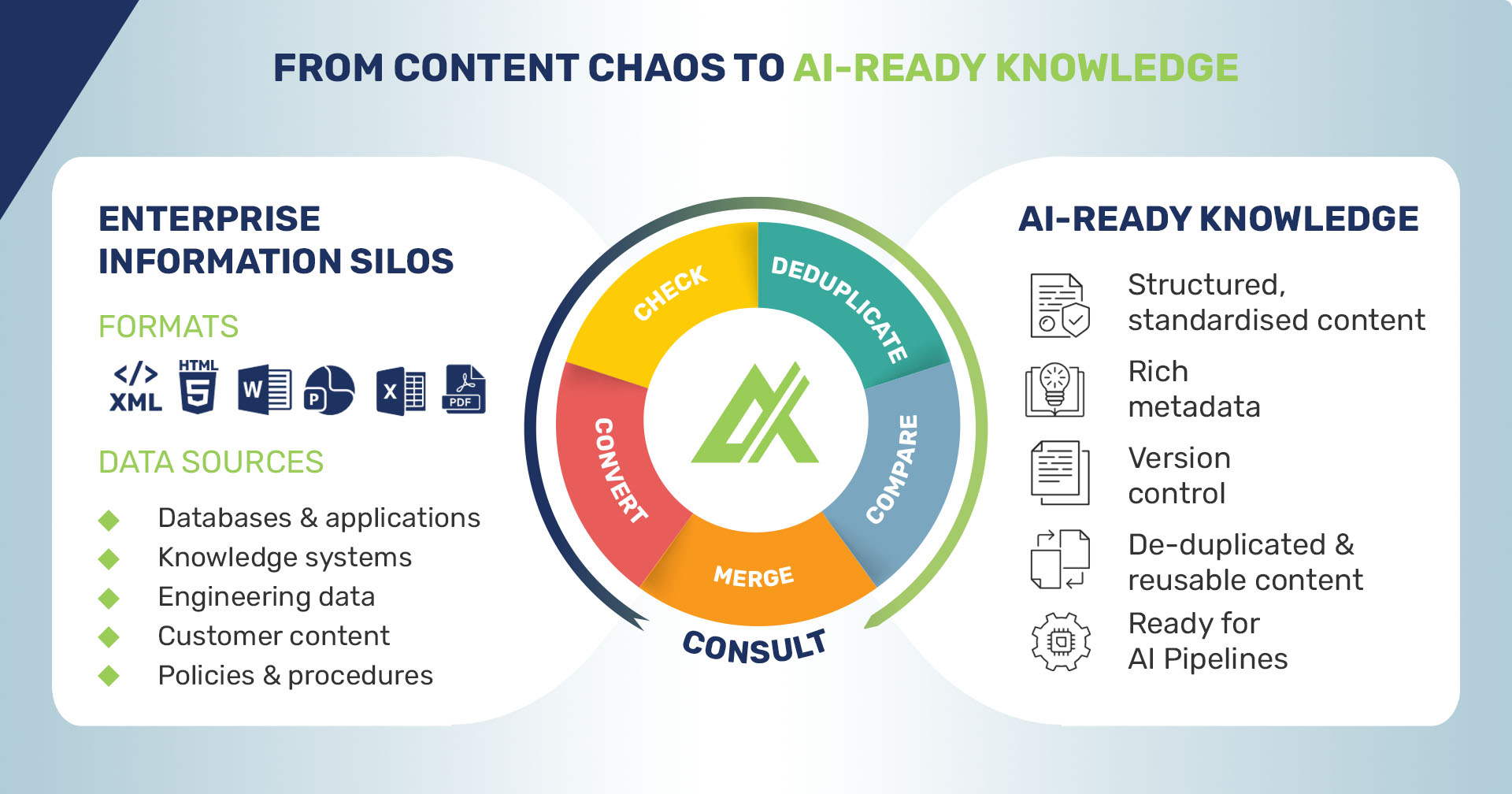
AI readiness requires ongoing governance as enterprise information continues to evolve. Maintaining quality means managing metadata, versions, content ownership and audit trails, while classifying information by product, component, region or regulatory requirements. These controls help ensure AI applications retrieve accurate, relevant information for the right context.
The result is a more reliable foundation for enterprise AI, built on information that can be understood, verified and maintained as it evolves.
As enterprises prepare their information for AI, these challenges are becoming increasingly relevant. For a large semiconductor manufacturer, this means tackling decades of legacy technical documentation and transforming it into structured, reusable knowledge that can support both existing operations and future AI applications.
The technology manufacturer is undertaking a large-scale migration of approximately hundreds of thousands of technical documents, with legacy content held primarily in PDF format alongside existing XML sources, including DITA.
The challenge extends beyond moving files between systems. Technical documentation contains complex structures, tables, images and references that must be preserved during conversion. The technology manufacturer also needs to maintain consistency across its documentation while preparing content for modern publishing and engineering workflows.
The objective is to transform legacy documentation into structured, validated content that can be maintained, reused and published more efficiently, without losing critical technical information.
Development of an automated migration workflow that brings together content conversion, validation and metadata enrichment.
The process focuses on several key stages:
This approach reduces reliance on manual content conversion and provides a more consistent process for managing complex legacy documentation.
By transforming legacy PDFs into structured, validated content, the technology manufacturer is working towards a more efficient and maintainable technical documentation environment. The approach is designed to deliver benefits across several areas:
The wider value goes beyond replacing legacy document formats. By improving the structure, consistency and accessibility of technical information, the manufacturer is laying the groundwork and processes for the heavy lift of legacy content cleaning, conversion and management. Whilst doing so it is setting up the future business and usual (BAU) pipelines and processes to support new content to ensure the reliability of their AI applications now and into the future. Addressing practical legacy content challenges is the first and important step towards enterprise AI readiness.
AI readiness starts with information you can rely on. At DeltaXignia, we've spent more than 30 years working with organisations to address complex content and data challenges, driving change intelligence managing change in content and data at enterprise scale to ensure information accuracy and consistency. Our patented technology is trusted by the Global Fortune 500 companies, designed into their systems and workflows and trusted to provide them with change intelligence clarity in their large-scale production environments.
Get in touch to explore how DeltaXignia can help you transform complex enterprise content into structured, reusable and AI-ready knowledge through automated conversion, validation, comparison, merging and deduplication.



From ISO Quality Services Ltd.


