Our Solution
Our Solution
DeltaNova
By Business Case

Version Control & Collaboration

Data Consistency & Management

AI & Automation
By Industry

Aviation

Manufacturing

Legal

Financial Services

Life Sciences
Our Solution
DeltaNova
By Business Case
Version Control & Collaboration
Data Consistency & Management
AI & Automation
By Industry
Aviation
Manufacturing
Legal
Financial Services
Life Sciences
Last updated: 31 July 2026
Enterprises can no longer afford to manage change through fragmented processes, manual reviews, and disconnected systems. As digital operations become more complex, organisations need the ability to ensure that every change across data, content, and systems is visible, validated, traceable, and trusted.
This is the new competitive requirement: trusted change.
The organisations that succeed over the next decade will not simply be those that automate more workflows. They will be the organisations that can trust the integrity of change across their operations and systems of record. Across the modern enterprise, critical information lives inside platforms such as component content management systems (CCMS), enterprise content management (ECM), product lifecycle management (PLM), enterprise resource planning (ERP), human resource management (HRM), customer relationship management (CRM), financial systems, regulatory repositories, supplier management platforms, and operational databases. These systems are designed to act as authoritative sources of truth for different parts of the business. Yet information constantly moves between them - transformed, duplicated, reformatted, reviewed, and republished across workflows, teams, and downstream systems.
This challenge is increasingly recognised across the industry. Gartner’s emerging concept of TrustOps reflects the growing need for organisations to operationalise trust as a measurable and governable capability rather than treating it as a passive outcome. In many ways, trusted change is becoming a foundational operational pillar of TrustOps. Gartner predicts that 50% of enterprises will invest in disinformation security and TrustOps by 2027.
Without trust in how change is managed across enterprise systems, digital transformation slows down, compliance risk increases, operational inefficiencies multiply, and decision-making becomes unreliable.
Modern enterprises operate in environments where change happens continuously. Product specifications evolve inside PLM platforms. Customer records change within CRM systems. Financial information updates across ERP environments. Employee data moves through HRM systems. Technical documentation is revised inside CCMS and ECM platforms.
At the same time, information flows between these systems into reports, supplier communications, regulatory submissions, APIs, analytics environments, AI models, machine-readable outputs, and automated operational workflows.
The challenge is no longer limited to managing documents or datasets in isolation. Enterprises must now maintain consistency and trust across highly interconnected digital ecosystems where information moves continuously between structured and unstructured formats. A product update may begin as structured XML inside a PLM environment, flow into HTML publishing systems, appear inside PDF documentation, populate JSON APIs, generate machine-readable outputs for downstream automation, and ultimately drive operational workflows across suppliers, partners, and customers.
The problem is that most organisations still manage these changes using fragmented governance processes, isolated tools, and manual validation activities that were never designed for today’s digital complexity. As a result, organisations struggle to maintain confidence in the consistency and integrity of information across their systems of record and downstream workflows.
Updates made within one platform may not be reflected correctly elsewhere. Product information stored in a PLM system may differ from published technical documentation. Customer or supplier records may drift between CRM and ERP environments. Regulatory documentation may no longer align with operational source data or machine-readable outputs consumed by downstream systems. These inconsistencies compound over time as information moves across business units, suppliers, workflows, APIs, and technologies. The risk becomes particularly acute where change criticality is high and change complexity is significant, including regulated industries, technical publishing, manufacturing, financial services, healthcare, aerospace, life sciences, and large-scale enterprise operations.
In these environments, even small inconsistencies introduced during transformation, publishing, reconciliation, or automated workflow execution can create serious downstream consequences including compliance failures, operational disruption, inaccurate reporting, or customer impact.
Without the correct configuration, banking operations can't take place; planes have to be grounded."
- Steve, Network Manager - IBM Network Configuration Manager
Most organisations still attempt to manage this complexity through manual comparison and reconciliation processes. Teams spend hours reviewing documents side-by-side, validating transformed data, reconciling spreadsheets, comparing XML or JSON outputs, or investigating discrepancies between systems. These activities slow delivery, increase operational cost, and introduce further risk through human error. This is not work that AI can tackle at this stage. It’s probabilistic algorithms are not designed to tackle this challenge which requires precision, accuracy and a result that can only be achieved by deterministic algorithms ensuring the same answer every time based on identical inputs.
The pace of enterprise change continues to accelerate. AI adoption, cloud migration, increasingly interconnected supply chains, and expanding digital ecosystems are creating environments where information moves continuously across systems and stakeholders. A single business process may now involve updates flowing across ERP, CRM, PLM, ECM, HRM, supplier systems, data lakes, and analytics platforms. Traditional governance models struggle to keep pace with this level of complexity.
What was once manageable through periodic review cycles now requires continuous validation, traceability, and oversight. Enterprises need the ability to understand not only what changed, but whether those changes remain accurate, compliant, and safe to use downstream. This aligns closely with Gartner’s broader direction around TrustOps and AI TRiSM (AI Trust, Risk and Security Management), where governance, resilience, explainability, and operational trust are converging into integrated enterprise disciplines. This is no longer a technical challenge, it’s a business resilience challenge.
To address these challenges, enterprises can adopt an operational approach built around change intelligence. Change intelligence creates an execution layer that makes enterprise change safe, provable, and actionable across systems of record, documents, datasets, and workflows. Rather than relying on fragmented manual processes, organisations create their ability to continuously detect, reconcile, validate, and govern changes across both structured and unstructured information.
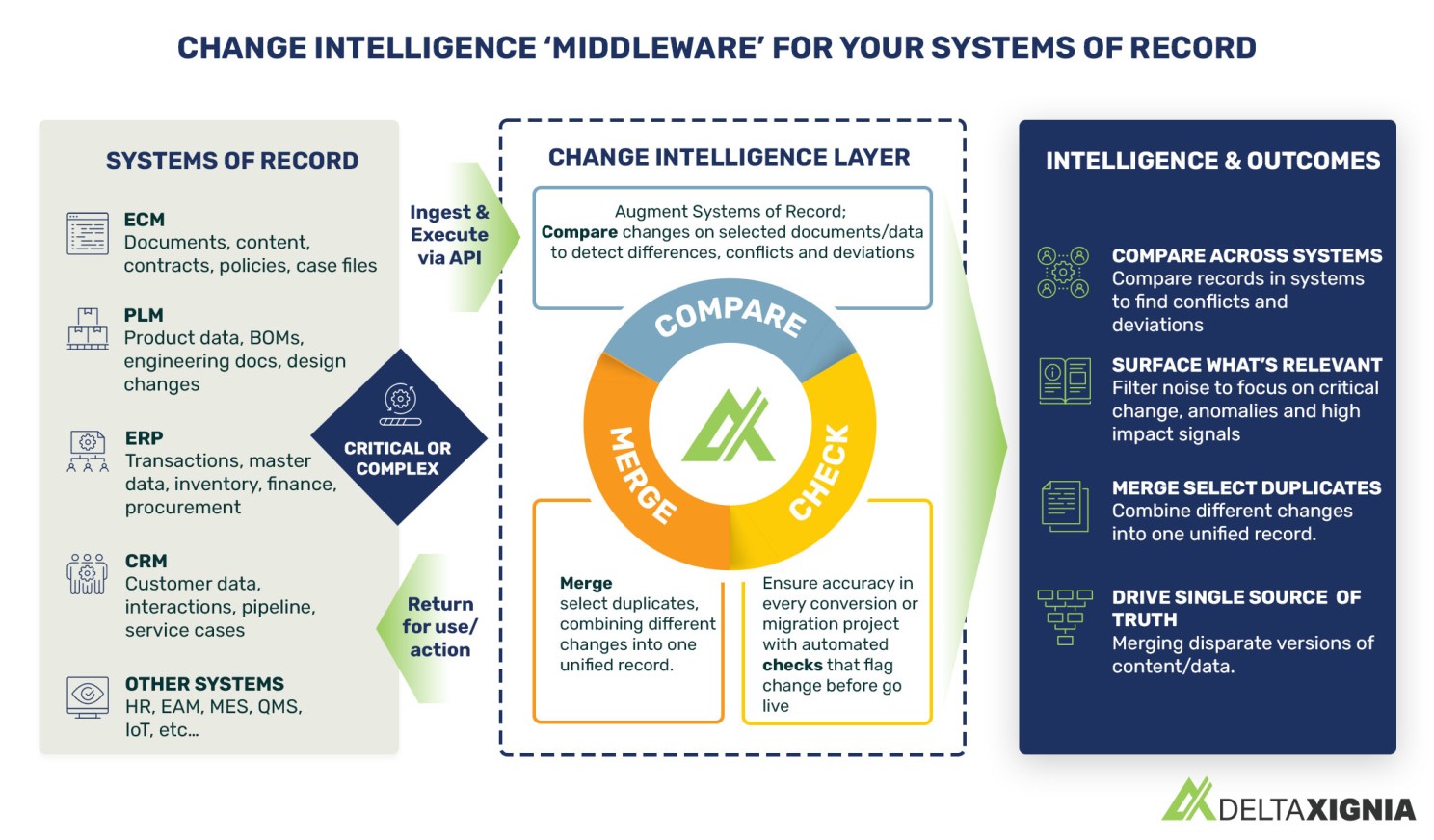
Instead of discovering problems after they create downstream impact, organisations can identify discrepancies immediately across enterprise systems and workflows. Large and complex documents, datasets, and records can be compared safely and consistently in seconds rather than hours. Automation handles large-scale comparison and validation, while human oversight focuses on exceptions, governance decisions, and compliance requirements.
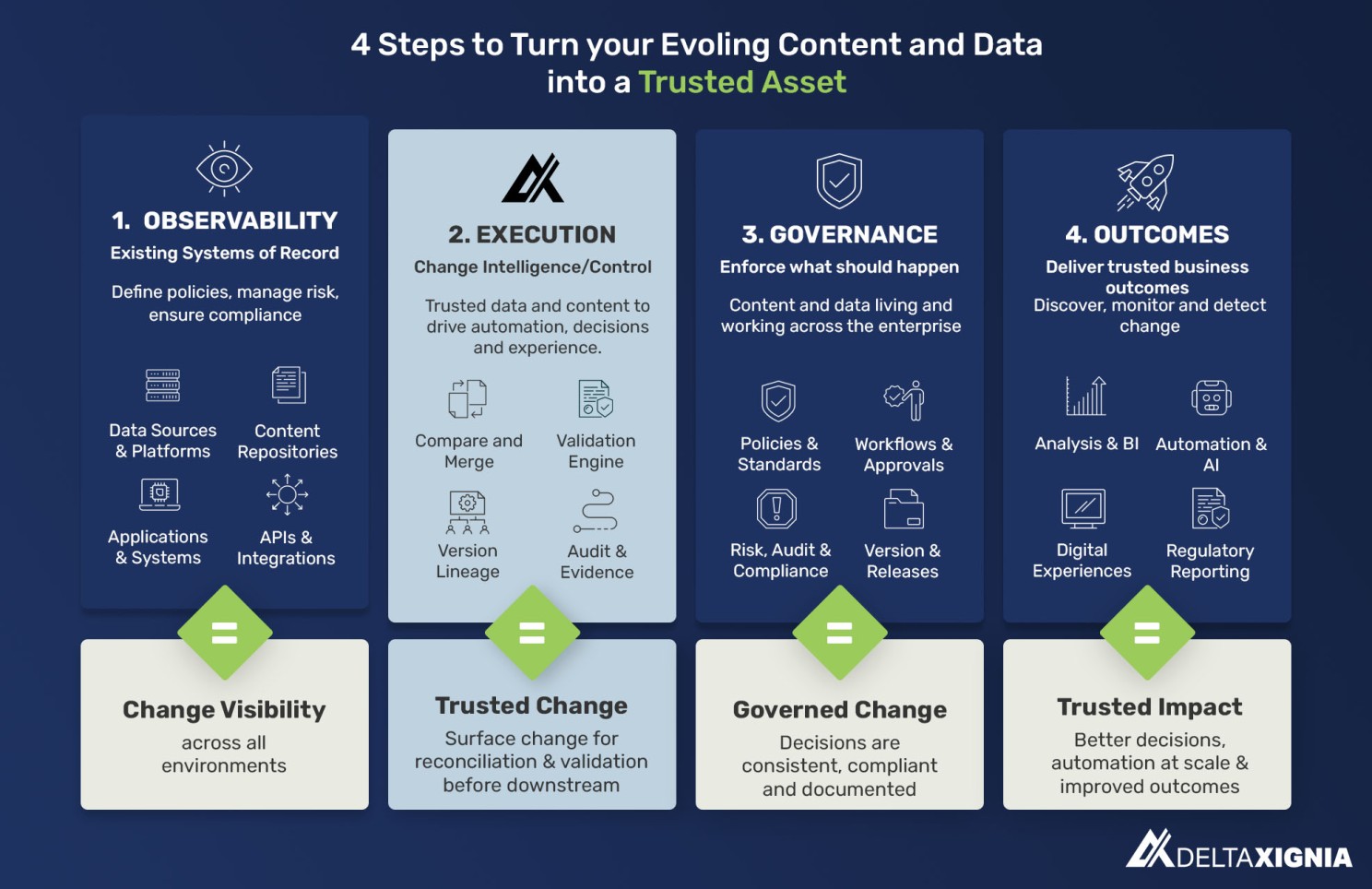
At the same time, organisations gain complete traceability of change activity across systems and downstream processes. Every change can be tracked, validated, audited, and explained. The result is greater efficiency and confidence in enterprise information. Increasingly, confidence itself is becoming a measurable operational capability.
The operational impact of trusted change is significant. Organisations implementing intelligent change management capabilities are reducing manual validation effort while dramatically accelerating review and reconciliation cycles. Millions of changes can be processed accurately at scale across enterprise systems without proportionally increasing operational overhead.
At the same time, organisations improve the consistency and reliability of downstream outputs. Teams spend less time resolving discrepancies and more time focusing on innovation, customer outcomes, and strategic priorities.
Compliance and governance also become more effective. Full traceability and audit readiness provide organisations with greater confidence in regulated environments, particularly as expectations around accountability, explainability, and AI governance continue to increase. Trusted change improves both operational performance and organisational resilience.
The need for trusted change is becoming urgent. As enterprises continue adopting AI, automating workflows, and expanding digital ecosystems, the volume and velocity of change will only increase. Hence driving the Gartner predictions of 50% of enterprises investing by 2027, as organisations respond to growing concerns around transparency, AI risk, governance, and digital integrity.
The future belongs to enterprises that can establish trust across their systems of record and information environments. That means building operations where change is not hidden, misunderstood, or uncontrolled but continuously detected, validated, governed, and traceable across every enterprise platform. Trusted change is becoming a foundational capability for the modern digital enterprise.
DeltaXignia’s DeltaNova solution provides the change intelligence layer that enables organisations to turn change into trust where it matters across the enterprise. By detecting, validating, reconciling, and governing change across structured and unstructured information, DeltaNova helps enterprises operationalise trust across systems of record, workflows, documents, and data ecosystems.
Whether comparing complex technical documentation, reconciling enterprise data from ERP and CRM systems, managing change in regulated content, or downstream transformation integrity, DeltaNova enables organisations to scale content and data change intelligence with confidence, traceability, and control. Check. Compare. Merge. Decide.
Trusted change is becoming a core enterprise capability as organisations struggle to manage growing complexity across interconnected systems, content, and data. Enterprises need confidence that change remains visible, validated, traceable, and aligned across their digital operations.
Get in touch to explore how to turn evolving enterprise content and data into trusted assets through continuous change detection, validation, reconciliation, and governance, reducing risk while enabling resilient, scalable transformation.
From ISO Quality Services Ltd.


